
Umbria, five unmissable places in Foligno: why you shouldn’t miss them in the heart of the center of the world

Beyond the clichés of the region: a journey into the heart of the “Rose of Umbria” among Baroque masterpieces, noble palaces, cosmic enigmas, and the first printed edition of Dante’s Divine Comedy
by Giovanni Bosi, Foligno / Umbria / Italy
Umbria is a land that never ceases to surprise. While towns such as Assisi, Spoleto and Gubbio have long attracted international visitors, there is a city in the Umbrian Valley that in recent years has experienced a true cultural and artistic renaissance, establishing itself as a premier destination for curious and discerning travelers. We are talking about Foligno. Traditionally known as the “Center of the World” — a title historically associated with the old Sassovivo Café and its legendary billiard pin — Foligno differs from most Umbrian towns thanks to its flat urban layout, making it ideal for exploring on foot or by bicycle.
(TurismoItaliaNews) The city’s true treasure lies in its extraordinary architectural heritage, where the Middle Ages blend seamlessly with Baroque splendor rarely found elsewhere in the region. For those planning to discover this Umbrian gem, here are five places that simply cannot be missed, along with the reasons why they deserve a place on your itinerary.
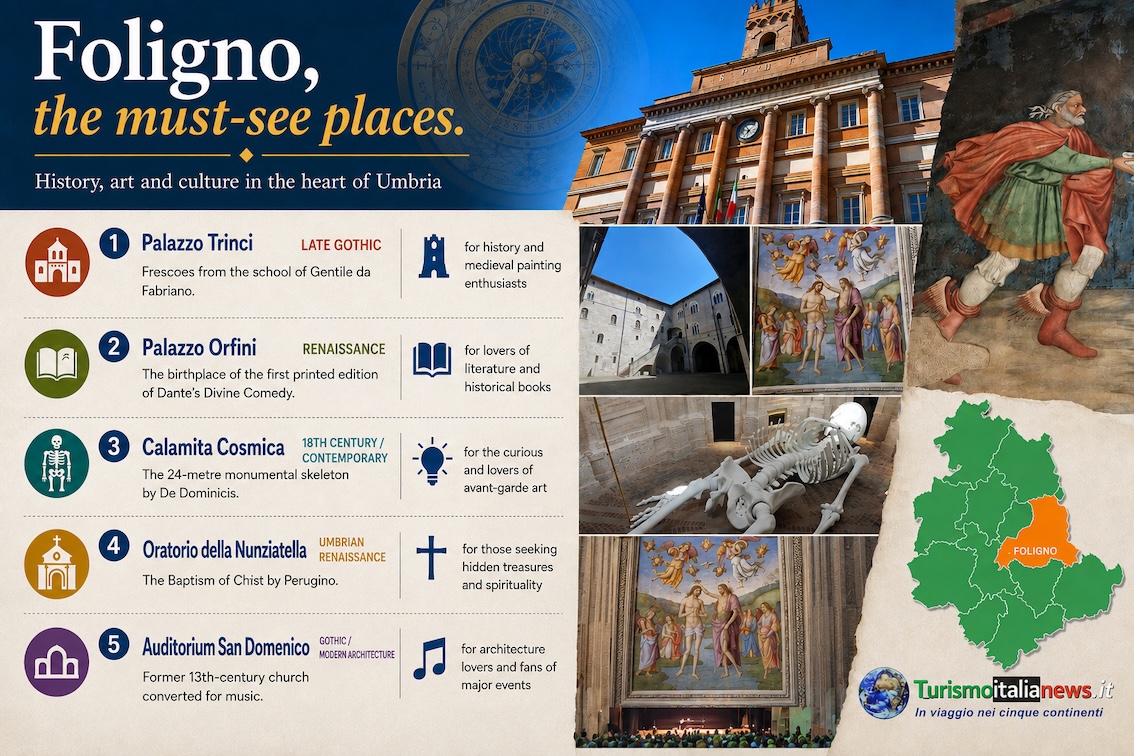

1. Palazzo Trinci
Why visit? To immerse yourself in one of the most important Late Gothic fresco cycles in Europe.
Widely regarded as the city’s monumental symbol, Palazzo Trinci was the residence of the family that ruled Foligno between the late 14th and early 15th centuries. Its Neoclassical façade can be deceptive: once you step inside and ascend the Gothic staircase, you find yourself surrounded by magnificent frescoed halls.
The masterpiece: the hall of the Liberal Arts and the Planets and the Hall of the Giants, whose frescoes are attributed to the school of Gentile da Fabriano. Their exquisite details, vibrant colors, and courtly elegance offer an extraordinary glimpse into the life and philosophy of the early Umbrian Renaissance.

2. Printing Museum at Palazzo Orfini
Why visit? Because this is where the first printed copy of Dante’s Divine Comedy was produced. Just a short walk from the cathedral, in Republic Square, stands Palazzo Orfini. It was here that German printer Johann Numeister, together with Foligno native Emiliano Orfini, completed a historic achievement on April 11, 1472: the first printed edition of Divine Comedy by Dante Alighieri.
A cultural highlight: the museum not only recounts the history of papermaking and printing in Foligno—an important printing center since the 15th century - but also illustrates the revolutionary impact this event had on the Italian language and culture. For literature lovers, it is nothing short of a secular pilgrimage.

3. Calamita Cosmica (former Church of the Holy Trinity in Annunziata)
Why visit? For the astonishing contrast between Neoclassical architecture and contemporary art. Foligno is home to an avant-garde treasure that leaves visitors breathless. Permanently housed inside the former 18th-century Church of the Holy Trinity (Santissima Trinità) is Cosmic Magnet (Calamita Cosmica), the monumental sculpture created by Gino De Dominicis. The church itself was built between 1760 and 1775 by master builders Pietro and Giuseppe Buccolini, based on a design by the architect Carlo Murena.
The visual impact: the work depicts a gigantic anthropomorphic skeleton measuring 24 meters in length, perfectly intact except for its elongated bird-like beak. In its hand, the skeleton holds a golden rod—the “magnet”—symbolically connecting humanity to the cosmos. Resting beneath the dome of the deconsecrated church, the sculpture creates a visual and emotional experience unlike any other.

4. Oratory of the Nunziatella
Why visit? To discover Perugino’s hidden treasure. Often, the most remarkable treasures are concealed behind unassuming doors. Built at the end of the 15th century, the Oratory of the Nunziatella is a small chapel housing an artistic jewel of immeasurable value: *The Baptism of Christ* by Pietro Perugino, the master of Raphael.
The artistic detail: the fresco displays all the delicacy and mastery of perspective that characterize Perugino’s work, featuring an idealized Umbrian landscape in the background that conveys a profound sense of peace and spirituality. It is a quiet sanctuary, far from the crowds, where visitors can pause and contemplate pure beauty.

5. San Domenico Complex (San Domenico Auditorium)
Why visit? To witness the rebirth of a medieval temple transformed into a center for music and culture. The monumental former Church of San Domenico, dating back to the 13th century, overlooks one of Foligno’s most evocative squares. Following an extensive restoration project, the building was transformed into a modern multifunctional auditorium while preserving its Gothic character and the grandeur of its vast nave, once entirely covered with frescoes.
One more reason: in addition to the surviving fragments of 14th-century frescoes and the elegant bell tower rising above the city skyline, the auditorium is renowned for its exceptional acoustics. Attending a classical or jazz concert here offers a unique sensory experience in which history and contemporary culture engage in a fascinating dialogue.


Travel Tip
Foligno is not a city to be rushed through. It is a destination that rewards the attentive eye of the modern traveler—someone who can be moved by a 15th-century fresco and, moments later, be captivated by the provocative power of contemporary art. All of this can be enjoyed with a glass of Montefalco Sagrantino Docg, produced just a few kilometers from the city’s ancient walls.
Foligno, in the heart of Umbria and Italy, the town of “the Quintana”
Here is the Sistine Chapel of Foligno: the Oratorio del Crocifisso, an extraordinary Baroque casket that arouses "wonder and amazement"
© TurismoItaliaNews.it | All rights reserved
Giovanni Bosi, journalist, has produced reports from numerous countries around the world. From Libya and Syria to China and India, from various South American nations to the United States, as well as across Europe and throughout the many facets of Africa. He has a particular passion for archaeology and cultural heritage. His articles reveal a deeply personal and engaging interpretation of the places he visits, recounting the experiences he lives there. He is a witness who does more than simply observe and report: emotions and human connections are always at the forefront of his storytelling. He is the author of books and publications.
Email: Questo indirizzo email è protetto dagli spambots. È necessario abilitare JavaScript per vederlo. | X: @giornalista3