

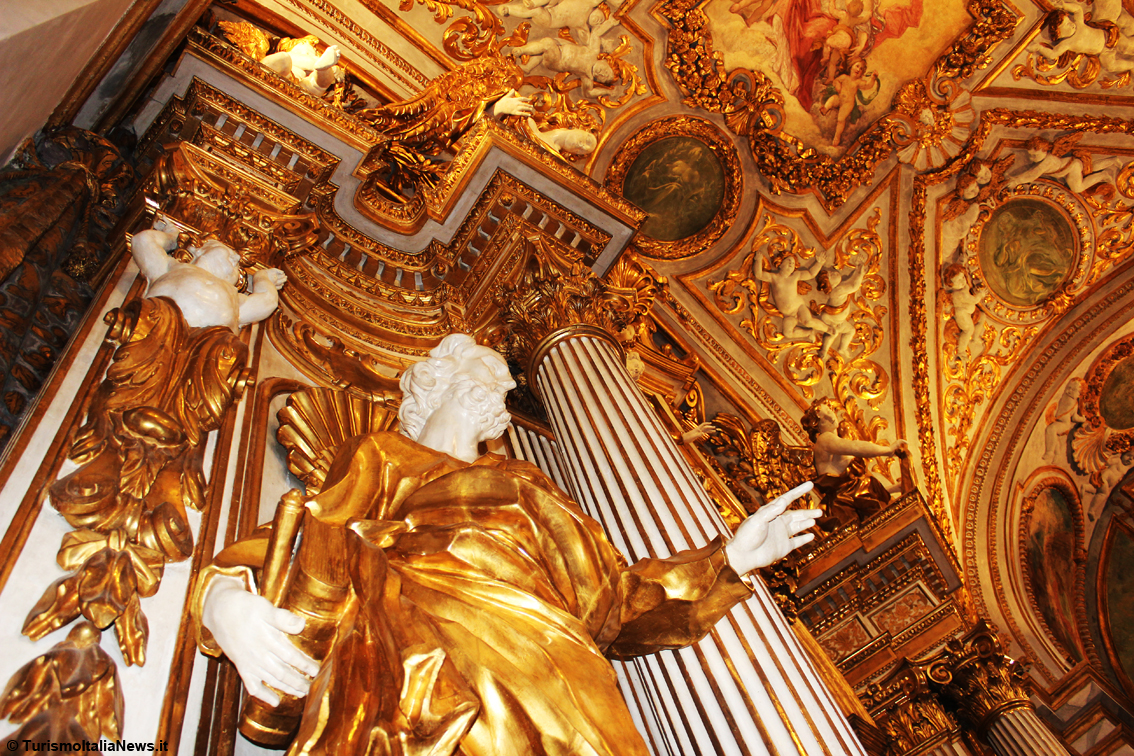
Here is the Sistine Chapel of Foligno: the Oratorio del Crocifisso, an extraordinary Baroque casket that arouses "wonder and amazement"
di Giovanni Bosi, Foligno / Umbria
A precious treasure chest. So beautiful that until you cross the modest wooden door that separates it from one of the oldest streets in the city that preserves it, you can't even imagine the emotion this masterpiece of art, still too little known, is about to reserve for you. And yes, it could be defined as the Sistine Chapel of Foligno, the center of the heart of Italy, Umbria.
(TurismoItalianews) Foligno is famous for being the center of the world, a license supported only by tradition but not by the geographical coordinates which the inhabitants of this very particular Umbrian city do not intend to give up. Very particular because in the context of Umbria, Foligno is the city of palaces par excellence built between the 15th and 18th centuries, far from the usual image one has of the medieval region. In short, a unique. And therefore Foligno deserves to be better known and valued for that extraordinary artistic and architectural heritage that follows one another street after street, demonstrating a rich and sumptuous past that has now practically all returned to its ancient splendor thanks to the recovery action undertaken on the buildings.


Among these, there is a place in Foligno that is absolutely not to be missed, where you can tiptoe in, where you can savor every moment of the beauty that your eyes capture, wandering from one point to another of the work of art that has been composed over the centuries, detail after detail. It is the Oratorio del Crocifisso, dating back to the 17th century, wedged between Palazzo Candiotti and the large Dominican church transformed into an auditorium, in the current Gramsci. When you arrive on site, you don't expect what you're about to find because despite being located between two very valuable buildings, the exterior layout is modest to say the least and in no way anticipates what is kept inside.
But when you enter, you immediately understand the value of those frames, those gilded stuccos, those well-kept inlays, those statues and those paintings on the walls. Until 2002 it belonged to the Confraternita del Crocifisso, which exchanged it with the Municipality of Foligno, following the earthquake of 1997 it underwent a long restoration process costing almost one and a half million euros, which served to restore the sacred building to its original splendor built by that Confraternity in three successive phases from the second half of the 16th century to the early 18th century.


 A recovery that has made it possible to put back in their place works previously kept in the deposit of the City Museum in Palazzo Trinci: the oil painting on canvas on which Christ and the Blessed Antonio da Stroncone are represented; an oil painting on canvas originally placed above the second altar on the right dedicated to San Pietro d'Alcantara; a painting where Saint Helena is represented; another painting on linen canvas depicting the Madonna of the Rosary. But it is the overall aspect that captivates the visitor's gaze, such as the monumental wooden decoration of the high altar, with the wooden Crucifix created by Pompeo Scarscioni in 1570; the coffered ceiling executed in the years 1629-31 by Francesco di Costantino Costantini, the famous "master of the Crucifixes"; the risen Christ, the angels and the cherubs, painted in tempera on wood in the chests of drawers, by Giovanni Battista Michelini from Foligno (1606 or 1613 - 1679); the frescoes on the vault of the presbytery; the dome; the two arched and carved wooden choir stalls were made in 1708 by Domenico Battistelli.
It is an infinite sequence of large and small works, born from the ingenuity and hands of more or less well-known artists and craftsmen, who have succeeded one another over the centuries in the embellishment of the Oratory. An authentic gem that stands out in Foligno's rich artistic endowment: from Palazzo Trinci with the cycle of frescoes attributed to Gentile da Foligno, to the Oratorio della Nunziatella with the Baptism of Christ by Perugino.


Address: largo Federico Frezzi
Opening hours: saturday e sunday 10 - 13 / 16 -19
Free admitance
info 0742-330584 / 600
Questo indirizzo email è protetto dagli spambots. È necessario abilitare JavaScript per vederlo.
Giovanni Bosi, journalist, has made reports from many countries around the world. From Libya and Syria, to China and India, from the various countries of South America to the United States, up to the various European nations and Africa in its many facets. He particularly loves the theme of archeology and cultural heritage. From his articles emerges a passionate reading of the places he visits, of which he recounts the experiences lived there. As a witness that he doesn't just watch and report: the motions of the heart are always at the forefront. He is the author of books and publications.
mail: Questo indirizzo email è protetto dagli spambots. È necessario abilitare JavaScript per vederlo. – twitter: @giornalista3
